

Die casting offers high production efficiency,excellent dimensional precision,and great structural versatility,making it widely used for manufacturing components from aluminum,zinc,and magnesium alloys.Porosity—manifesting as internal voids,surface pinholes,or clusters of small holes—is a frequent quality defect in die castings.It compromises material density,structural integrity,and airtightness,while also leading to failures in subsequent coating or oxidation processes,often resulting in product scrap.Identifying the root causes of porosity and implementing targeted process improvements can effectively resolve this issue.
Excessive gas content in the molten metal is the primary source of porosity.During the melting process,the molten metal absorbs hydrogen,oxygen,and water vapor from the atmosphere.Without proper degassing,this gas cannot escape during the mold-filling stage and becomes trapped as pores upon solidification.Process improvements should focus on strengthening melt control:strictly regulating melting temperatures to prevent excessive gas absorption at high heat;using refining agents or vacuum degassing to remove dissolved gases;and maintaining melt purity to minimize gas entrapment caused by impurities.
Poor mold venting leads to gas entrapment within the die cavity.Die casting involves rapid filling and a tightly sealed cavity;if venting channels are poorly designed,clogged,or insufficient in number,air cannot escape in time.Instead,it becomes encapsulated within the molten metal under high pressure,creating clusters of pores.Optimization strategies include redesigning the venting structure by adding more vents and overflow wells,and adjusting vent depth and location to cover melt flow fronts and"dead zones."Regular cleaning of carbon deposits and aluminum slag from vents ensures unobstructed airflow,while optimizing venting at the parting line further enhances overall venting efficiency.
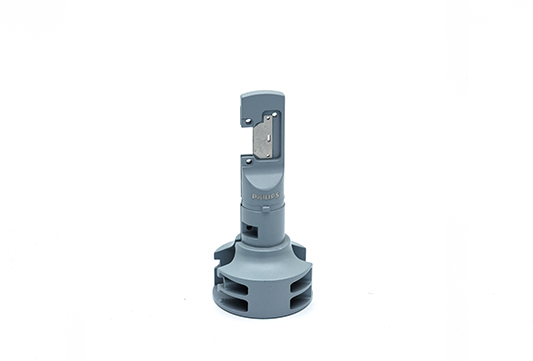
Improper die casting parameters exacerbate porosity defects.Excessive filling speeds,insufficient injection pressure,and excessively high mold temperatures can all trigger porosity issues.Excessive injection speed causes turbulent flow,trapping large amounts of air;insufficient pressure fails to compact internal voids;and excessively high mold temperatures increase gas solubility,leading to gas precipitation and pore formation upon cooling.Process parameters must be precisely calibrated:employ a multi-stage,slow-fill process to minimize air entrapment;apply appropriate injection pressure to compact microscopic voids;and maintain a stable mold temperature to prevent gas precipitation caused by excessive thermal gradients.
Improper control of raw materials and ambient humidity leads to defects.Moisture in raw materials,water content in remelted scrap,or high workshop humidity generates significant water vapor during melting,directly causing porosity.Strictly control raw material storage to prevent moisture absorption and mold;pre-dry remelted scrap to remove moisture and impurities;and maintain a dry,well-ventilated melting environment to minimize moisture generation at the source.
Improper application of release agents causes porosity.Excessive spraying or poor atomization leaves residual moisture and solvent vapors in the mold cavity,which vaporize at high temperatures to form pores.Optimize the spraying process by ensuring uniform atomization and controlling the quantity and location of the spray to avoid localized accumulation;allow sufficient time for evaporation after spraying so that solvents and moisture dissipate completely before closing the mold for casting.
By implementing degassing and purification,optimizing mold venting,calibrating process parameters,controlling the environment and raw materials,and adjusting spraying techniques,porosity defects in die castings can be systematically resolved,thereby enhancing material density,surface quality,and structural performance.
